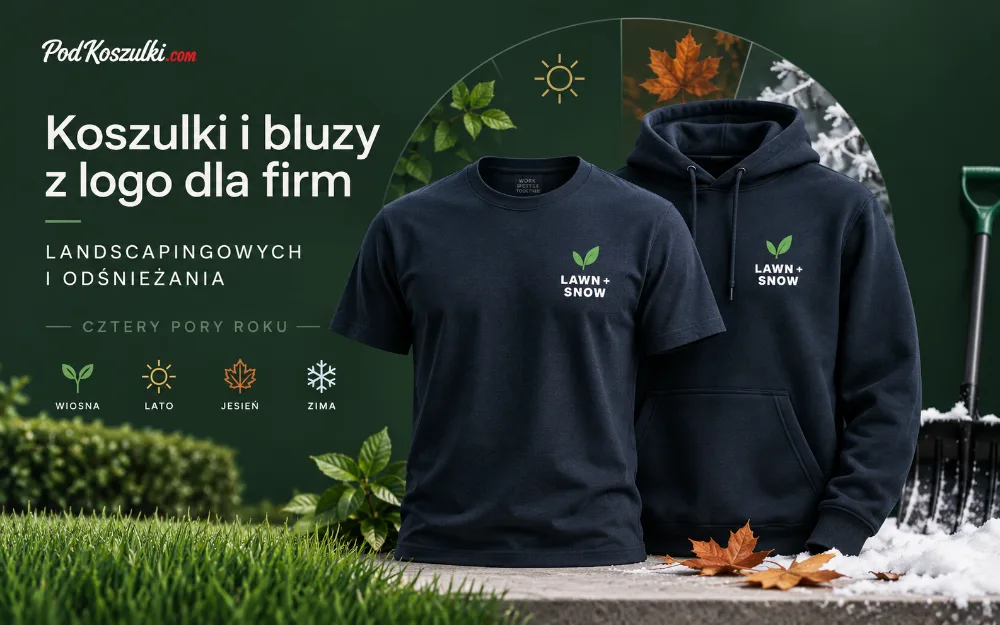
Custom Hoodies with Your Company Logo — How to Dress Your Crew for a Chicago Fall and Winter
From October to April in Chicago the t-shirt goes under cover — what people see is the hoodie. Here is how to pick fabric weight, cut and color for a logo hoodie, where to put the print, and when to order so your crew stays warm and recognizable for half the year.
In Chicago, short-sleeve season lasts four, maybe five months. The rest of the year your crew, your customers and your fans wear a hoodie on top — which means the logo on their t-shirt disappears under layers from October on. A custom hoodie with your company logo is the simplest way to keep your brand visible even when the wind off the lake makes taking your jacket off for more than a minute a bad idea.
This guide grew out of the questions we hear from Polish-American businesses and organizations across Chicago and the suburbs: what fabric weight, hood or no hood, how big should the back print be, why do hoodies "run" a size bigger, and what is the latest we can order so the crew has them before the first frost. We answer them one by one — and at the end you will find a checklist of what to have ready before you order.
Why a hoodie, not just a t-shirt
A logo t-shirt is the foundation of any company wardrobe — cheap, light and easy to restock as the team grows. But it has one weakness: in the cold months nobody sees it. A hoodie solves that, and does something a tee never will — people wear it voluntarily after work. At the grocery store, at the gas station, at their kid’s soccer game. Every one of those outings is free exposure for your logo in the places your future customers live.
Industry research backs up what you see on the street. According to the Advertising Specialty Institute, a single piece of logo apparel generates several thousand brand impressions over its lifetime, and hoodies and jackets are among the longest-kept promotional products of all. In a 2026 Custom Ink survey, 67% of buyers said a company apparel design only makes sense if people wear it by choice — and that is exactly why a well-chosen hoodie beats a t-shirt hands down: it is the piece your employee takes home.
6+ months
of hoodie season in Chicago — October through April
67%
of buyers say company apparel only works when people wear it by choice
10 pcs
minimum order — any mix of sizes and colors
5–7 days
business days of production after proof approval, shipping across the US
Who orders logo hoodies — four typical scenarios
A printed hoodie is a universal product, but every group of buyers needs something different. Below are the four most common scenarios we see from customers in Chicago and other states — find the one closest to yours.
Logo hoodies — who orders them and why
Who orders
What they need
What we recommend
Contractors and service companies
A warm layer for job sites and customers’ homes that matches the summer t-shirts
Heavyweight pullover hoodie, dark color, big back print with the phone number
Restaurants, bars, food trucks
Merch for the staff and for customers that builds the venue’s brand
Midweight, unisex cut, chest logo plus a slogan on the back
Polish schools, parishes, sports clubs
Hoodies for students, teams and volunteers — often with names
Youth and adult sizes in one order, name or number print
Fan clubs and one-off events
A dozen or so pieces for a road trip, a tournament or a family reunion
Full-color graphic print, light logo on a dark background
Want to see what a full-color print looks like on dark fleece? Take a look at our Lewandowski hoodies — printed with the same technique we use for company orders. For more on the garment itself, see the glossary entry on the hoodie.
Fabric weight and material — 8 oz or 12 oz?
In the US, fleece weight is given in ounces per square yard, and it is the first number worth checking. Midweight hoodies (around 8 oz) are lighter, cheaper and comfortable indoors in a heated space — a good fit for restaurant, retail or office staff. Heavyweight hoodies (10–12 oz) have dense, brushed-inside fleece, hold heat outdoors and look "expensive" — the pick for crews working outside and for anyone who wants the hoodie worn for years. We explain how to read these numbers in the glossary entry on fabric weight.
The fiber content matters for both printing and washing. The most popular cotton-poly blend (say 50/50 or 80/20) shrinks less and dries faster than pure cotton, and the polyester helps the hood and cuffs keep their shape after dozens of washes. Pure cotton is softer and more breathable, but it can drop half a size in the first wash — worth factoring in when you order.
Pullover, zip or crewneck — which cut to choose
The three basic sweatshirt cuts differ not only in looks, but in how big a print they can carry. The classic pullover hoodie offers the largest uninterrupted surface on the back and chest. A zip-up hoodie is easier to throw on in the truck or on site, but the zipper splits the front in two, so only a small left-chest logo fits up front. A crewneck — a sweatshirt without a hood — looks neater under a jacket and is the favorite of restaurants and offices.
Sweatshirt cuts and print space
Cut
Front print
Back print
Best for
Pullover hoodie
Left-chest logo or a large center graphic
Full surface — company name and phone readable from a distance
Field crews, clubs, merch
Zip-up hoodie
Left chest only — the zipper splits the front
Full surface
Contractors, drivers, service techs
Crewneck (no hood)
Left chest or center
Full surface
Restaurants, offices, customer-facing staff
Colors people actually wear
A hoodie has to work for years, so pick the color for the people, not the trend. Market research and our own order stats say the same thing: black, navy, charcoal and heather gray account for the vast majority of company hoodies, because they suit any logo, hide the marks of a day’s work and embarrass nobody after hours. A light logo on a dark background also reads from across the street — especially in winter, when dusk falls in Chicago before five.
Save your brand color — red, green, blue — for the print itself, or for a second, "dress" batch of hoodies for the owner and managers. The exception is clubs and schools, where team colors matter more than versatility; there, a red or white hoodie with a name across the back is exactly what parents and fans expect.
Where to put the print on a hoodie
A hoodie offers more room than a t-shirt, but it has its own traps: the kangaroo pocket, the zipper and the drawstrings. The proven layout for businesses is a small logo on the left chest — visible in conversation — and a big back print with the company name, phone number and website that works like a billboard whenever an employee has their back to the street. More on both spots in the glossary entries on the left-chest print and the back print.
Left chest — a logo 3–4 inches wide; on a zip-up, the only front placement
Center front — a large graphic or slogan, pullovers only; stay above the kangaroo pocket
Back — company name, phone, website; start the print a few inches below the hood so it does not get covered
Sleeve — a short slogan, web address or flag; a good spot for a second, subtle accent
Hood — better not: it folds, and the print is rarely visible in full
You can check the composition right away in the online designer — pick a hoodie, move the logo around the chest and back, choose colors and see the per-piece price and a preview of the whole order. Only have a logo from a business card or a photo on your phone? We prepare the print file for free, and you get a design proof to approve before anything is printed.
Design logo hoodies for your crew
Pick a cut and color, place your logo on the chest and back — the per-piece price shows right away, and you get a proof before we print. Support in English and Polish.
A hoodie is a tougher canvas than a t-shirt: thick, fuzzy fleece, dark colors and a wash every few days through the cold months. That is why we use DTF printing on hoodies — a full-color transfer with a white underbase that gives vivid, opaque colors on black and navy fleece, where classic direct printing fades out. The print is flexible, does not crack at the folds and survives dozens of washes.
For dressier pieces for owners and managers — a zip-up with a small chest logo, for instance — we recommend embroidery: a raised, textured logo that, on heavy fleece, looks like it came off a premium store shelf. Many customers combine both: print for the crew, embroidery for the managers, the same logo on everyone. How to care for a hoodie so the print looks new for several seasons is covered in the entry on print care.
„We have had logo t-shirts for three years, but the hoodies are what did the job — the guys wear them on weekends, and in winter I get calls from people who "saw your hoodie at Jewel-Osco."”
— HVAC company owner from Chicago’s northwest suburbs (illustrative testimonial)
Sizes and how many to order
A hoodie goes over a t-shirt, often with another layer underneath, so people usually order it one size up from their t-shirt size. The unisex cut is wide in the shoulders — offer the women on your team a size down, or go straight for a fitted model. In one order you can freely mix sizes from S to 5XL, and for Polish schools and clubs — youth sizes too.
How many? Experienced customers order headcount plus 15–20% spare in the most common sizes (L and XL). A new hire in November gets a hoodie on day one instead of a week later, and you avoid placing a reorder for three pieces. Bigger orders bring the per-piece price down, and from 40 pieces shipping is free — the mechanism is the same one we describe in our guide to cheap custom printed t-shirts.
When to order — the Chicago season calendar
The first mornings below 50°F usually reach Chicago in early October, and with them comes the wave of hoodie orders. Production takes 5–7 business days after proof approval, but the closer you get to November, the more it pays to have your order behind you, so you are not waiting on blank suppliers to restock the popular sizes.
Order calendar for logo hoodies
When
What is happening
What to do
September
Last warm weeks; blank suppliers are quiet
Design the hoodies and collect sizes from the crew
October
First cold mornings, hoodie season begins
Place the order — the crew wears them by the first frost
November
Thanksgiving, peak of holiday orders
Reorder missing sizes; hoodies as employee gifts
December–February
Deep winter, dark before 5 pm
A big, light back print works best — the crew is visible from a distance
March–April
Fickle spring, layers on and off
The hoodie as a layer under the work jacket; time to plan summer t-shirts
The whole order happens online, in English or Polish, with no trip to a print shop. Before you sit down at the designer, get a few things from the list below ready — then the design takes fifteen minutes.
Your logo in the best version you have — we prepare the print file for free
A decision: pullover, zip-up or crewneck — and whether the crew needs a hood
A size list from your employees (remember: a hoodie usually runs one size up from a t-shirt)
Text for the back: company name, phone number, website
Hoodie color — for businesses we recommend black, navy or charcoal
The date you need the hoodies by (production takes 5–7 business days)
Have it all together? Open the online designer, pick a hoodie, upload your logo and place it on the chest and back — the per-piece price shows right away, and you get a proof to approve before we print. We ship to all 50 states, and around Chicago you can pick up your order in person. This winter, let your logo be the layer on top.
What fabric weight should I pick for a crew working outdoors in Chicago?
Heavyweight — 10–12 oz. Dense, brushed fleece holds heat in the wind and looks solid for several seasons. Lighter hoodies around 8 oz work well in heated spaces: a restaurant, a store or an office. For the whole company it is best to pick one model, so the logo looks identical on every piece.
Pullover hoodie, zip-up or crewneck — which is better for printing?
For a big front print — a pullover hoodie or a crewneck. A zip-up has a zipper splitting the front, so only a left-chest logo fits up front; on the back, all three cuts give you the full surface for the company name and phone number.
Will the print on a dark hoodie be sharp and survive washing?
Yes. On hoodies we use full-color DTF printing with a white underbase, so colors on black and navy fleece come out vivid and opaque. The print is flexible, does not crack at the folds and survives dozens of washes. For dressier hoodies for managers we also recommend embroidery.
What hoodie size should I order — the same as the t-shirt?
Usually one size up. A hoodie goes over a t-shirt, often with an extra layer, and the unisex cut is wide in the shoulders. In one order you can freely mix sizes from S to 5XL, plus youth sizes — at no extra charge.
How much does a hoodie with a company logo cost?
The price depends on the model, fabric weight and quantity — the bigger the order, the lower the per-piece price, and from 40 pieces shipping is free. You see the exact price for your chosen hoodie with your logo right away in the online designer, before you order.
What is the latest I can order hoodies so the crew has them before winter?
Production takes 5–7 business days after proof approval, so an order placed in early October arrives before the first frost. Do not wait until November — it is peak season, and popular sizes can be temporarily out of stock at blank suppliers.